Visiting Doune Castle, Loch Katrine, and Loch Lomond
With my time as a Seasonal Retail Assistant at Edinburgh Castle soon coming to an end, the realisation that the loss of my Historic Environment Scotland free pass would follow hit me rather suddenly one September night. I had only ever used my pass once, and this was to let my boyfriend’s family visiting from Spain into the castle on my lunch break. It could grant me free entry into most of Scotland’s beautiful medieval castles under HES, from anywhere in the country. I panicked, ran through a few different options in my head, and texted my boyfriend.
There is one thing to note about my boyfriend: that man thinks nothing of jumping in the car and driving for hours. His car is merely an extension of himself. In two years, I have driven him maybe five times, and for no longer than 10 minutes. He drives us everywhere, and enjoys doing it. This was very beneficial for my castle plans. I informed him that I was thinking of Craigmillar Castle or Tantallon Castle, both only around a half hour drive from us. He then informed me that he would be willing to drive further, and that I could think beyond Edinburgh and the Lothians if I wanted to. Of course, I did. I spent the entire night searching HES sites and mapping the perfect route for a jampacked day of roadtripping before he could take back his offer.
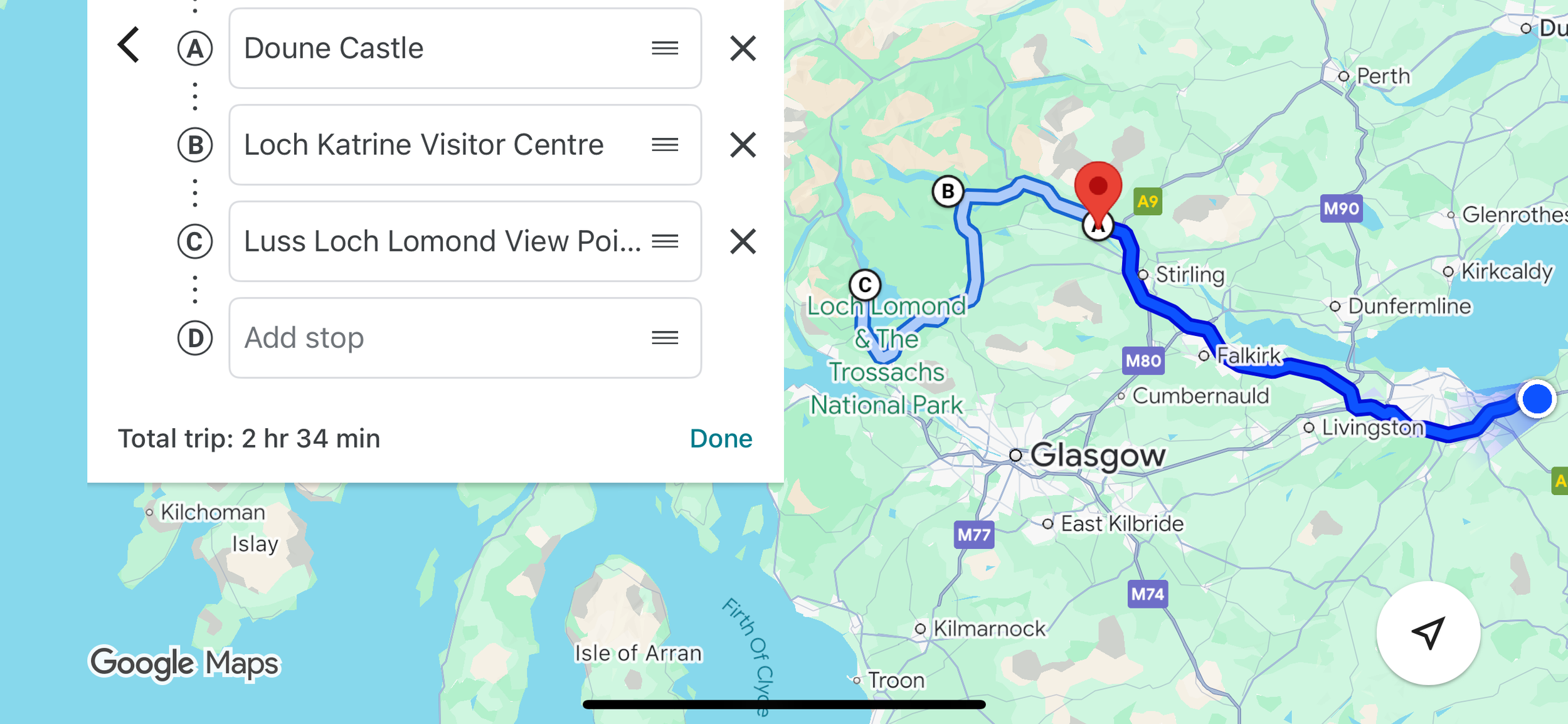
There are many places in Scotland I have been to, but was too young to remember or appreciate. And there are many places I still have yet to see. As such, I wanted a mixture of both on this day out. I ultimately landed on Doune Castle. Roughly an hour away from East Lothian, it was the perfect mixture of far enough away that I had no connection to it, but not too far that we would have to stay overnight. After all, we are both very much not early-risers, and would be setting off around 11am at the earliest. From there, I looked a little further west towards the many lochs that inhabit that area of Scotland. I immediately knew which I wanted to see: Loch Katrine. And, as Loch Katrine is situated within the Loch Lomond and the Trossachs National Park, we would, of course, conclude with Loch Lomond.
So we set off the next day. The drive up to Doune Castle was fairly straightforward. Starting with the A1 to Edinburgh, then the A701, then the M9 through Falkirk and Stirling, and finally into Doune. Very boring. We didn’t see much of the town, as we headed straight towards the castle. As we approached the carpark, a worker asked us through the window if we had pre-booked tickets. I informed him we didn’t, but I had my Historic Scotland pass, and showed it to him. “Which site are you?” he asked. When I replied, “Edinburgh Castle”, I didn’t receive much more than a small smile and nod. Clearly not very interesting to him. As the months have gone by at Edinburgh Castle, the scale of Edinburgh Castle compared to the rest of Scotland’s castles has become more and more clear; being the biggest tourist attraction in Scotland, and second biggest in the whole of the UK, there comes a sense of removal from it all. In fact, Edinburgh Castle brings in more annual revenue than the rest of the HES sites combined. I was probably one of many workers from Edinburgh, the big boring baddie, paying my respects to the little guy.
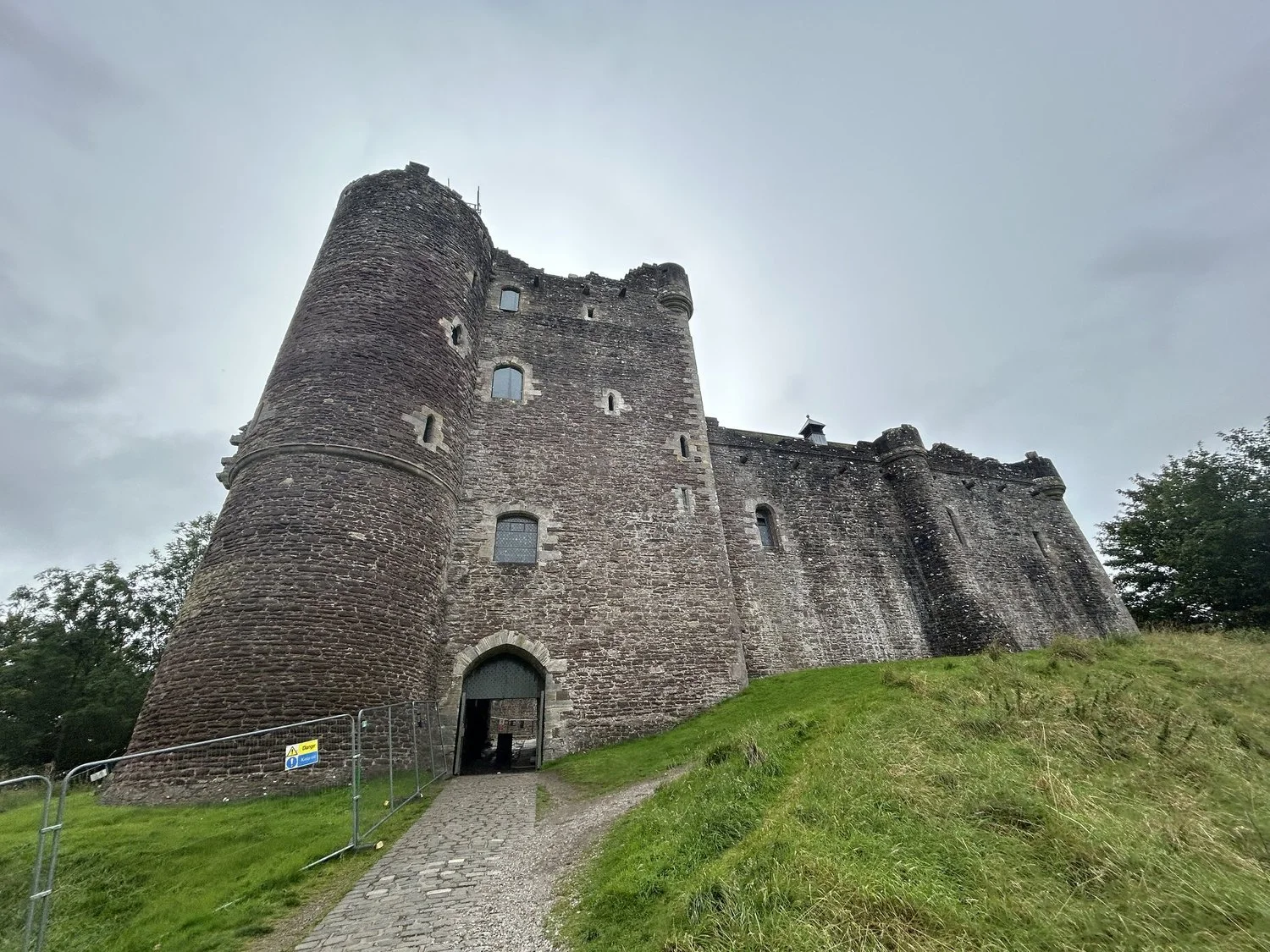
We eventually reached the castle, and I used my pass to gain free entry and a free audio guide. The audio was great, and added a lot to the experience. Doune Castle was one that I wanted to visit, not just because it’s a beautiful medieval castle, but because of its cultural significance in today’s age as well. It took on the role of Winterfell in the pilot episode of Game of Thrones, before the show moved to Northern Ireland. It also was noted in my favourite Scottish writer’s 1814 novel, Waverley, and featured in the 1952 adaptation of Ivanhoe. Most recognisably for me was its use in Monty Python and the Holy Grail, as the castle from which the French garrison taunt King Arthur and his Knights of the Roundtable. Most famously, however, surely must be its portrayal as the seat of Clan MacKenzie in the Outlander series, Castle Leoch. In fact, in various points in the castle, there were additional audio options voiced by the male lead, Sam Heughan, explaining the behind the scenes of the filming process.
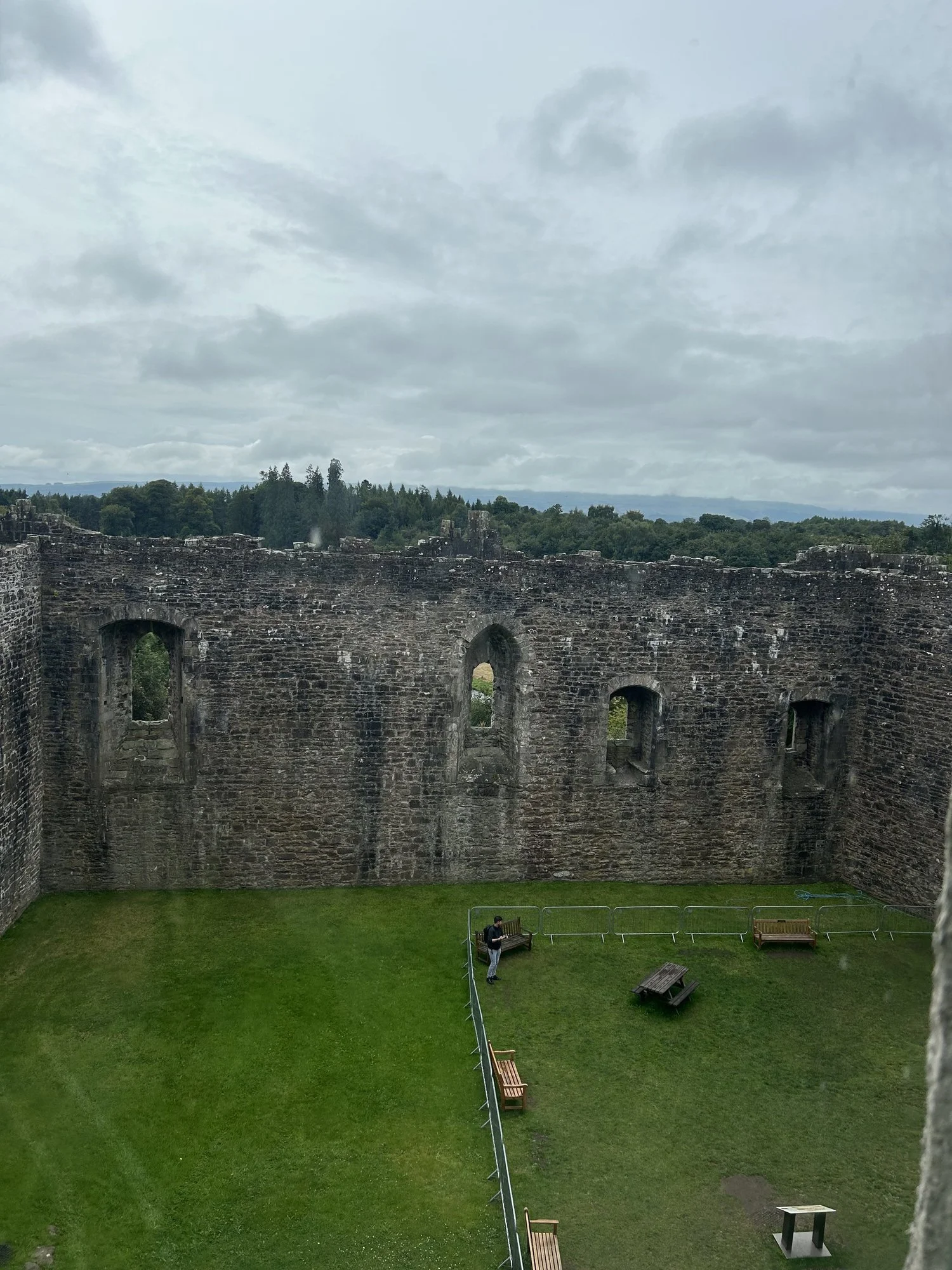
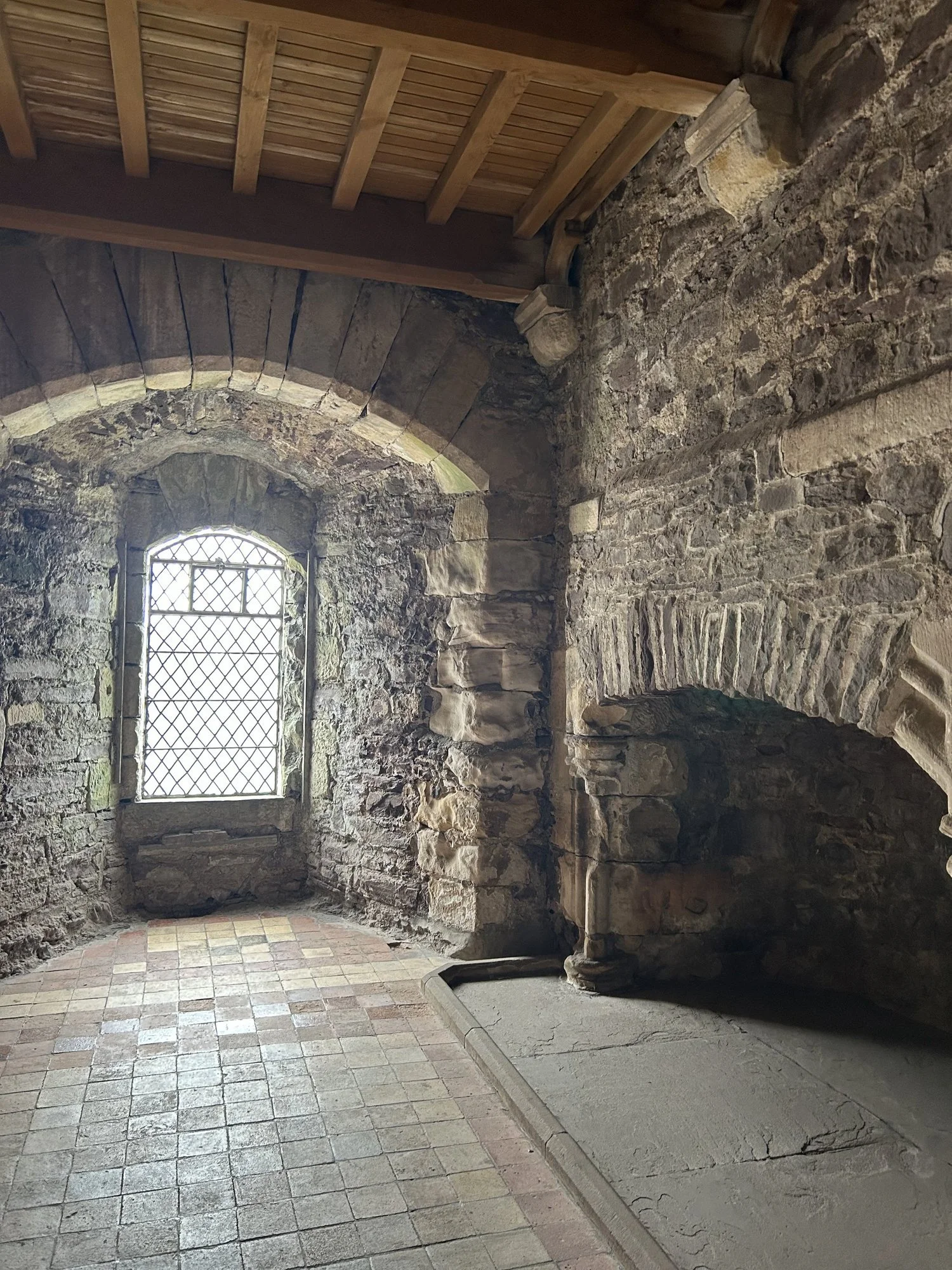
I was pleasantly surprised at how much could be visited from inside the castle; its exterior appears a lot smaller than it actually is. Of course, being a HES site, there were renovations in the outside section meaning scaffolding covered much of the walls by the courtyard, but most of the castle was still accessible. The Kitchen Tower was particularly impressive and memorable, boasting a large oven and fireplace. There are also many windows with stunning views across the surrounding greenery outside the castle grounds the further you travel up and into the various rooms and halls. Once we had seen the other rooms, notably the Great Hall, and the Lord’s Hall (which has a much more modern feel to it thanks to Victorian renovations), we headed back down for a wee nosy into the gift shop. It had most of the HES stock I’ve come to know and become sick at the sight of - saltire shortbread tins, Highland cow postcards, christmas decorations, blah blah blah. It did, however, have an interesting selection of Monty Python themed t-shirts that I did actually consider for a while. However, we ultimately controlled ourselves, and left the gift shop for a walk through the castle grounds.
We caught Doune on a great day. The sky looked grey and cloudy as so many Scottish skies often do, however the temperature was warm, there was no trace of wind, and the grounds looked incredibly green. We walked for a little while along the Ardoch Burn, which has a beautiful walking path to follow. We then walked in the opposite direction towards the old Roman fort, which is now just a field, so not quite as impressive as I had thought. Nonetheless, walking the castle grounds was a very pleasant and calming experience, great for exploring the more natural world surrounding the castle, and for exterior views of the castle itself. I saw many women walking up to the castle walls and touching the stone with both hands, waiting to be transported into their own Outlander world. I also found myself searching for recognisable spots from Monty Python where the French soldiers stood atop the ramparts. For one of Scotland’s smaller castles, it was a fairly busy experience that buzzed with history, both old and new.
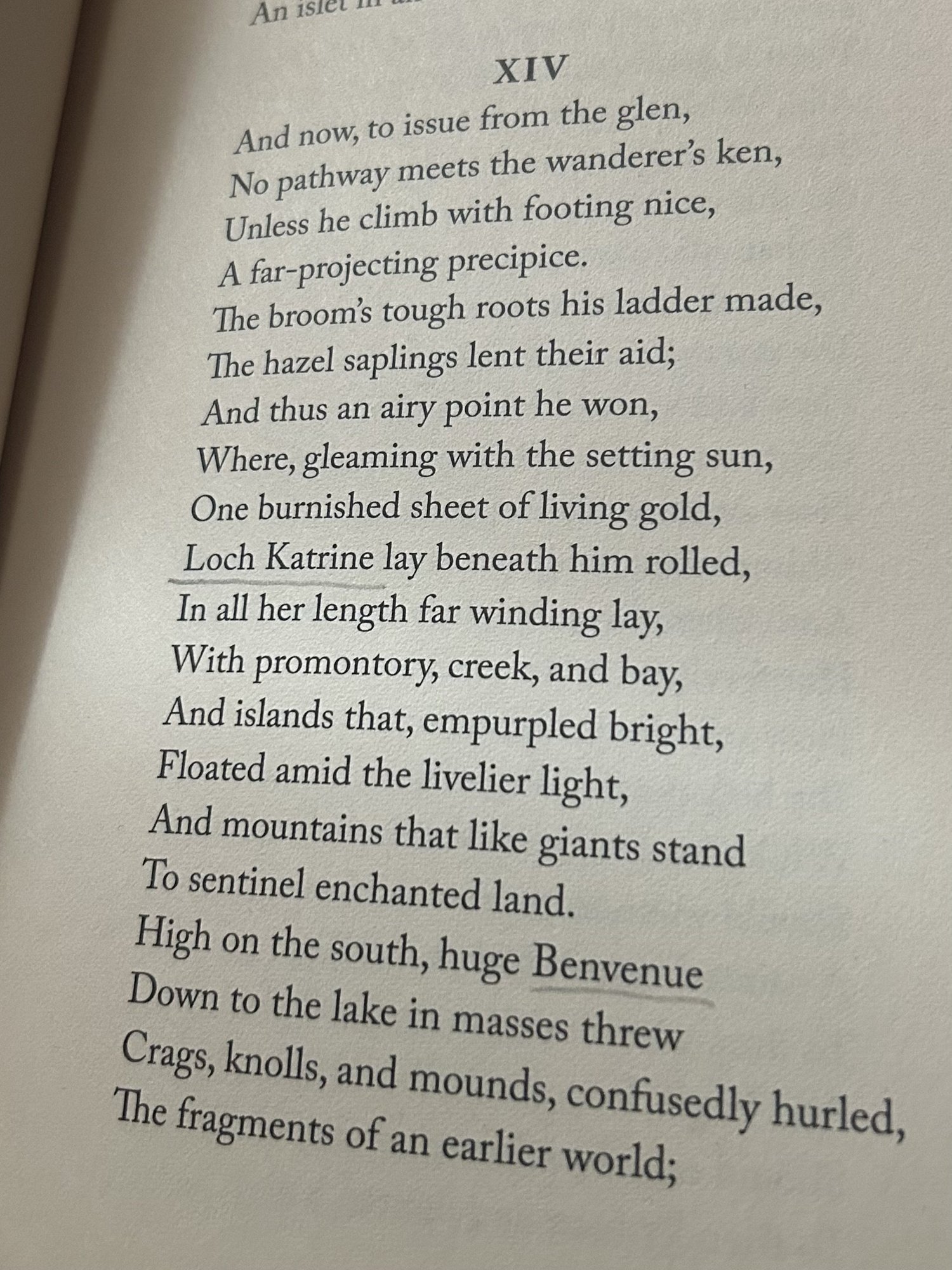
Eventually we moved on and entered our next destination into Google Maps: Loch Katrine. This was a location I was particularly looking forward to, due to my love for Sir Walter Scott’s 1810 narrative poem, The Lady of the Lake. The poem begins with a lost huntsman, James Fitz-James, wandering over to the shore of Loch Katrine and stumbling upon the beautiful Ellen Douglas, who rows over to help him. I studied this poem at university, and used it in my research for my dissertation on the influence of Scottish literature and landscapes on Romantic poets like Wordsworth, Byron, and Keats. My dissertation proved that the landscape writings of Scott were so influential, they caused a wave of tourism up to Scotland by many English poets, who partook in individual literary pilgrimages to see the same sublime sights.
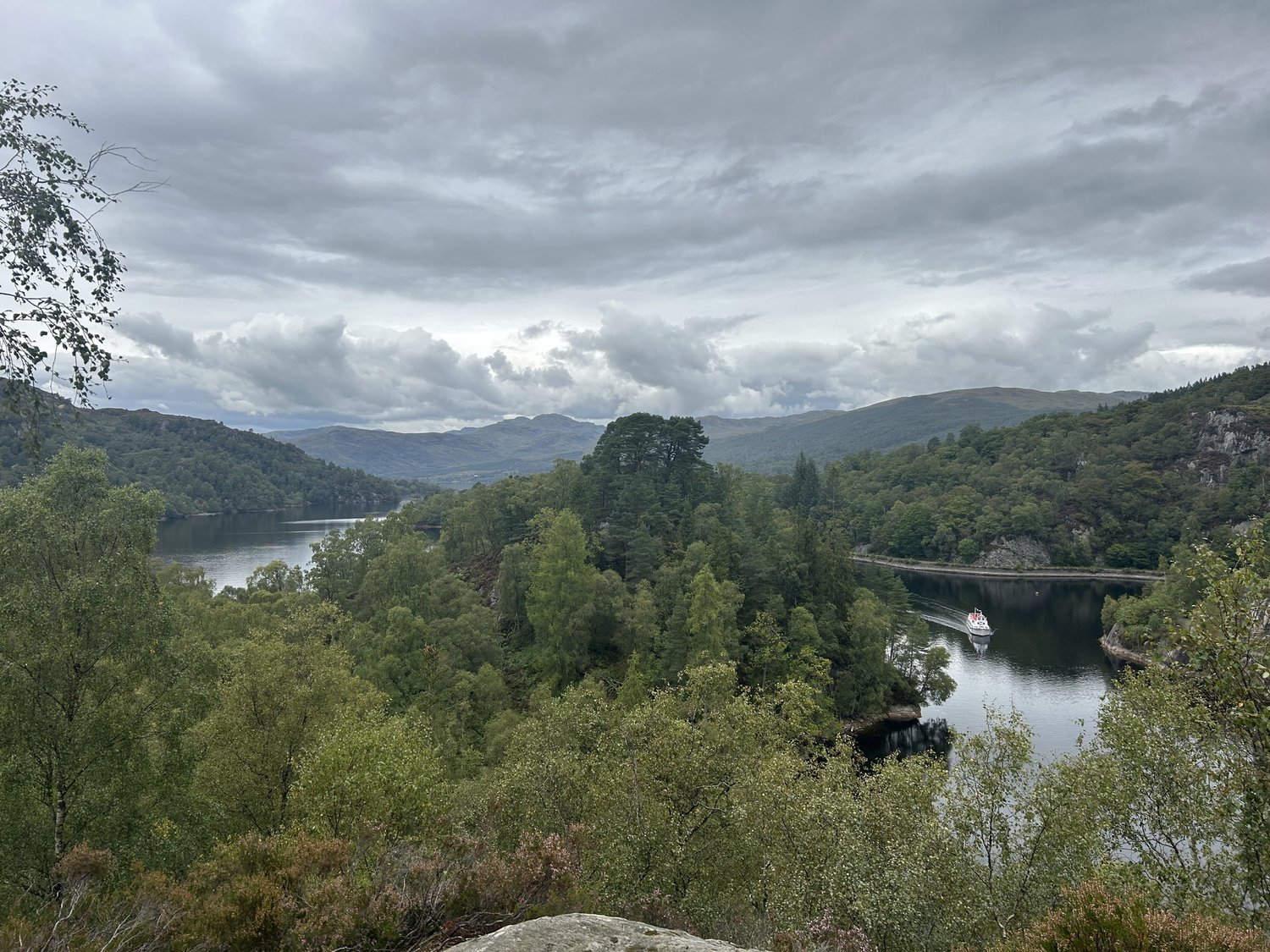
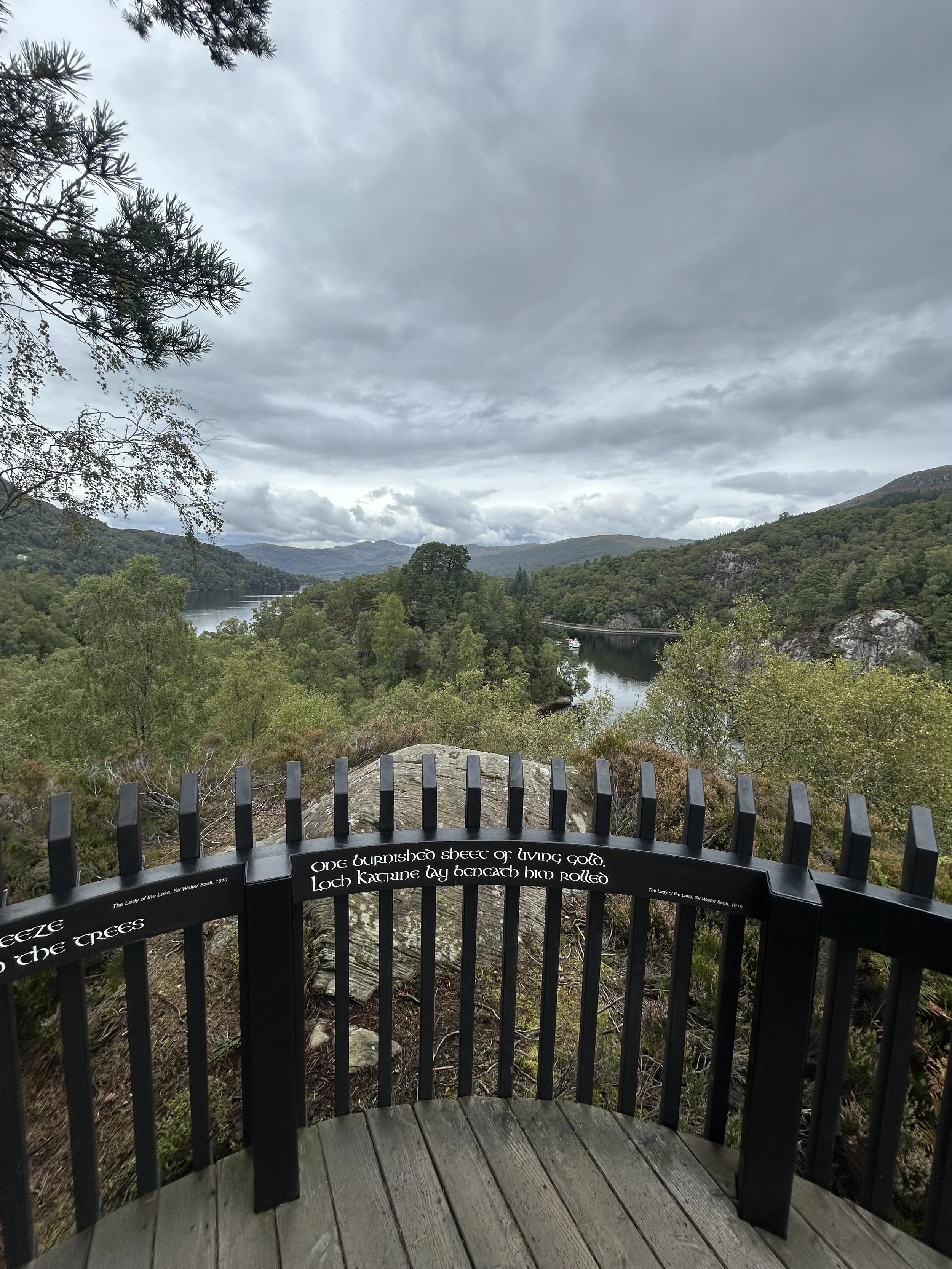
When we arrived at the visitor centre and made our way up the path, it became easy to understand why Scott chose such a destination for his poem, and why the English poets were so moved by the setting. The view from the top could only be described in the wonderful words of the Scottish poet himself - ‘So wondrous wild, the whole might seem / The scenery of a fairy dream’.
I stared at it for a long time. There were various levels of viewpoints to catch the winding water from various angles. It wasn’t busy; only one elderly couple passed us, and by that point we were ready to move for them. For the rest of the time, I stood and stared towards the water and the surrounding hills. It was so, so green, and unbelievably quiet. At one point, however, some bagpipes roared in the distance, much to our confusion. When we looked back down at the water, its tranquility was broken by a little white tourist boat gliding along the loch just below us, belting out the pipes as it went. They echoed around the hills, almost a whisper to us up above, but still traceable. I watched on in envy, wishing I could have such a closer inspection of the whole loch like these tourists could. I told myself that one day I would. The boat continued round the bend on the right, and was soon out of sight to continue on its journey.
I kept on staring, and I imagined James and Ellen on these very lands. I ran through the poem in my head. It brought me back to such a specific period in my life, and to a university I actually have very few fond memories of. But with Scott, stepping back into ‘Scott-land’, it felt like falling in love with literature all over again. I tried to explain it to my boyfriend, the feeling of connecting literature to the land: “I know it sounds geeky, but see thinking of the poem as you’re looking at it…”. I couldn’t even finish the thought without blushing, because he was laughing. I stopped, and just kept it to myself, my little moment, and I let it sit within me for a while.
I don’t think I’ve ever had such a visceral reaction to a landscape quite like I had at Loch Katrine. Not only because it is one of the most naturally beautiful sights I’ve ever seen, but because it brought with it so much feeling and emotion due to the centuries of human experiences imprinted upon its land. I thought of William Wordsworth, his sister, Dorothy, and Samuel Taylor Coleridge, who visited the loch on their own literary pilgrimages. I thought of Keats’s visit in 1818, following in their footsteps. Mostly, I thought of Scott, and how works of his like The Lady of the Lake made me forget, for a week, my dislike for my University of Edinburgh experience. My thoughts, like the ones of these great poets, intertwined with the land to create meaning, and my words written here, though perhaps not as eloquently put as theirs, are an attempt to decipher the feelings and emotions brought about by the sublimity of the same landscape, centuries apart. Loch Katrine inspired Scott’s poem, and in turn, Scott’s poem inspired a deeper appreciation of the setting that can still be felt by readers today. This harmonious relationship showcases the deeply intertwined nature of literature and landscape that can be found in so many Scottish scenes. The writer seeks meaning from the land, and in gaining it, provides the land with all the more meaning.
After staring out for about 20 minutes, it was time to gather my thoughts and move onto the final destination. We walked back down the long path and into the car, where we next typed Luss into Google Maps to get a view of the mighty Loch Lomond.
Loch Lomond is a sight I have passed by before, but can’t remember much of. Driving back along it, I began to realise that this was probably because the loch is almost completely covered by trees the whole way. There is little view of the loch until you actually park up and get out of the car. So we drove down, through green hills and windy roads, and then upwards onto the dual carriageway, and then we reached the village of Luss. There wasn’t much of the village to see, but what we did see was quaint, pretty, and touristy. Parking was free because the meter wasn’t working, which was an added bonus. We got out of the car to view our last destination.
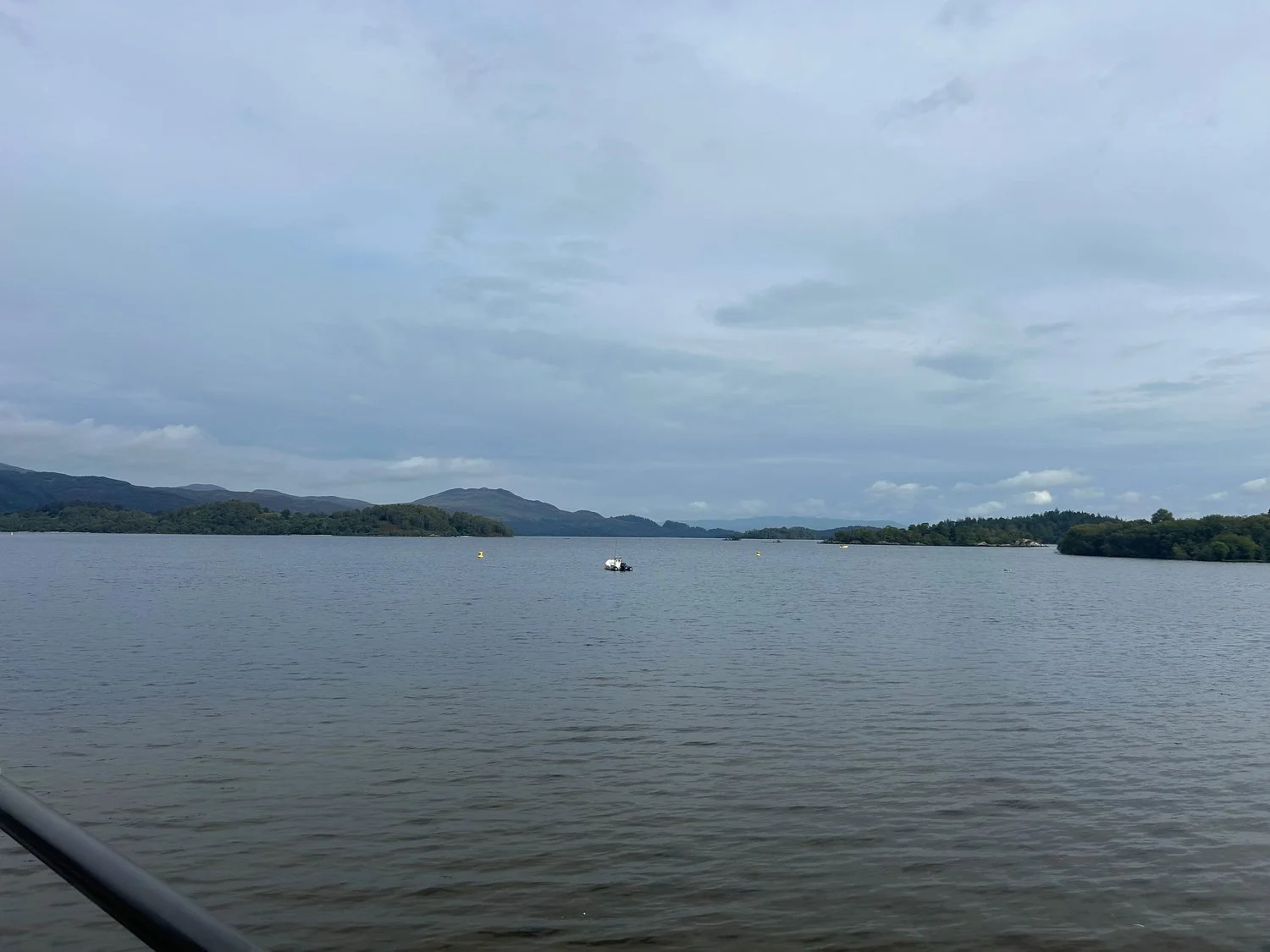
Where I was struck by the overwhelming greenery that surrounded and complemented the waters of Loch Katrine, I couldn’t help but notice just how blue Loch Lomond felt. Perhaps we caught it on a particularly misty day, but it felt as if sky and water were almost one. The hills in the background were fuzzy, due not only to the slight haze but also the sheer size of the loch; it engulfed me and my fellow visitors. We walked along the pebbley shore and then onto the pier. A few speed boats passed by, but other than that, the water was still, quiet, and vast.
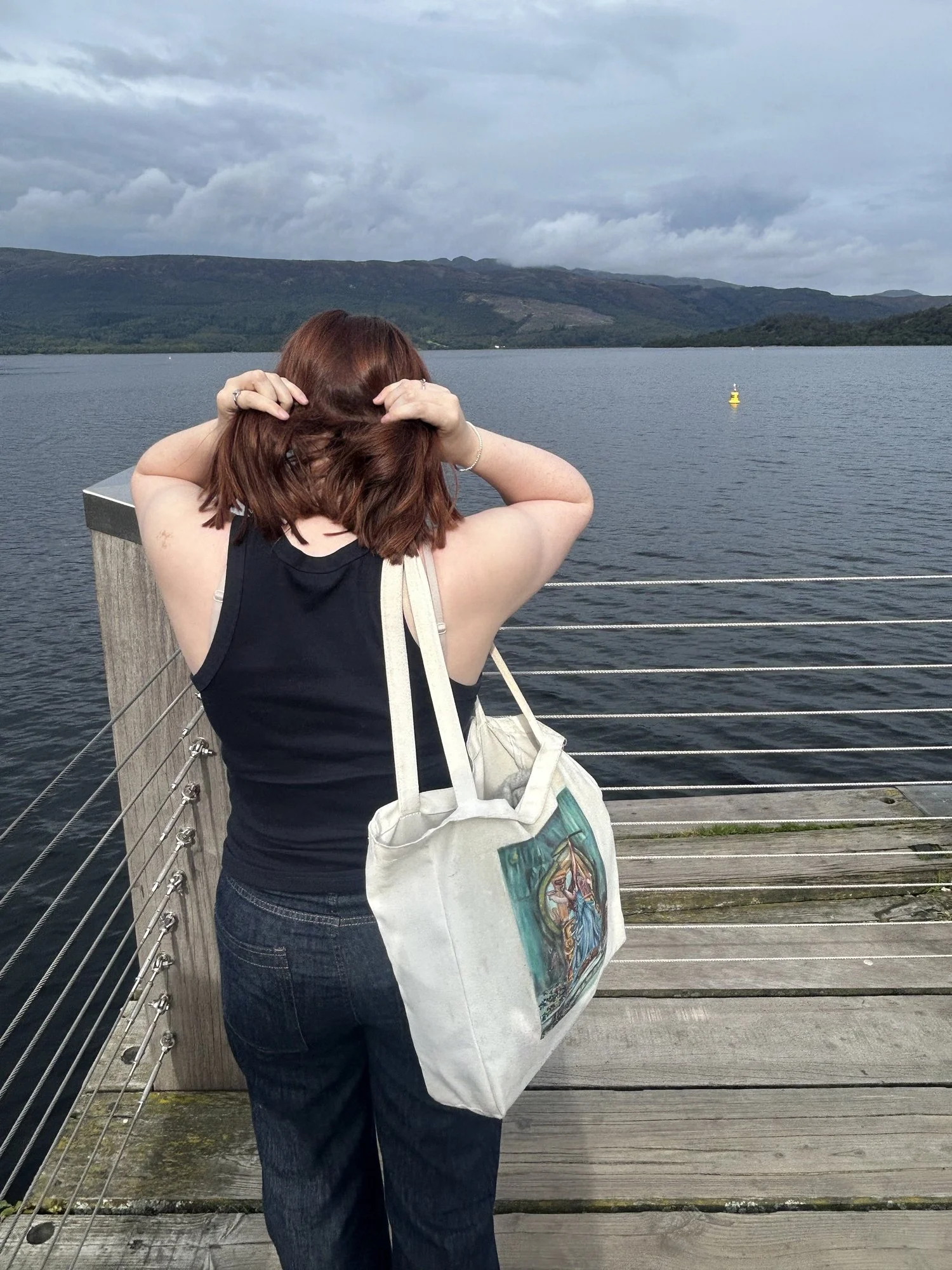
I took some pictures, but the camera struggled to pick up on what I was seeing. They came out a little too bland for my liking. I also had a few of me taken, but (despite the misty-looking weather) the sky was very bright and so I was actually squinting for most of them. Aside from that, however, it was a beautiful experience looking out onto Scotland’s largest loch. I could almost hear the Runrig cover in the distance, and the Tartan Army’s cheers.
And with that came the end of our journey. We ended up heading down to Glasgow for a quick dinner, and then made the drive back towards Edinburgh and into East Lothian. Overall, we were out for around eight hours. Thankfully, I also had the next day off work as well, so I could come home and relax for a while.
This trip was valuable to me, not only because it provided me with more insight into Scotland’s beautiful landscapes and buildings, but because it made me realise that I wanted to do something with this insight and experience. Scotland’s history, landscapes, and culture are so interesting to me, and where my passion lies. I want to try and explain the feelings I get when I get to go on a trip like this in some form, whether it's a blog or an Instagram account. So I set up both, and I plan on writing and filming experiences like these. Whether it’s visiting somewhere far away, or just a local area, I’m going to try to put it out into the world in some way and just see what happens. It’s a little scary, and I don’t quite know how I’m going to do it yet. There’s a part of me that wants to show my face and share my name, but then there’s a part of me that is a little embarrassed at people I know being able to see that. I know this shouldn’t bother me; most success stories began with someone putting themself out there and facing ridicule until their later success no longer made their boldness funny. Maybe at some point I’ll get there, or maybe I’ll choose to remain anonymous. Only time will tell.
Until then, I’ve created an Instagram account, @bloggingscotland. I plan on posting pictures I’ve taken in Scotland, filming some videos, and sharing some fun pieces of history. Hopefully, despite the incoming loss of my HES pass, I can find the time to visit more sites and document the process on this website and on Instagram. Wish me luck…